
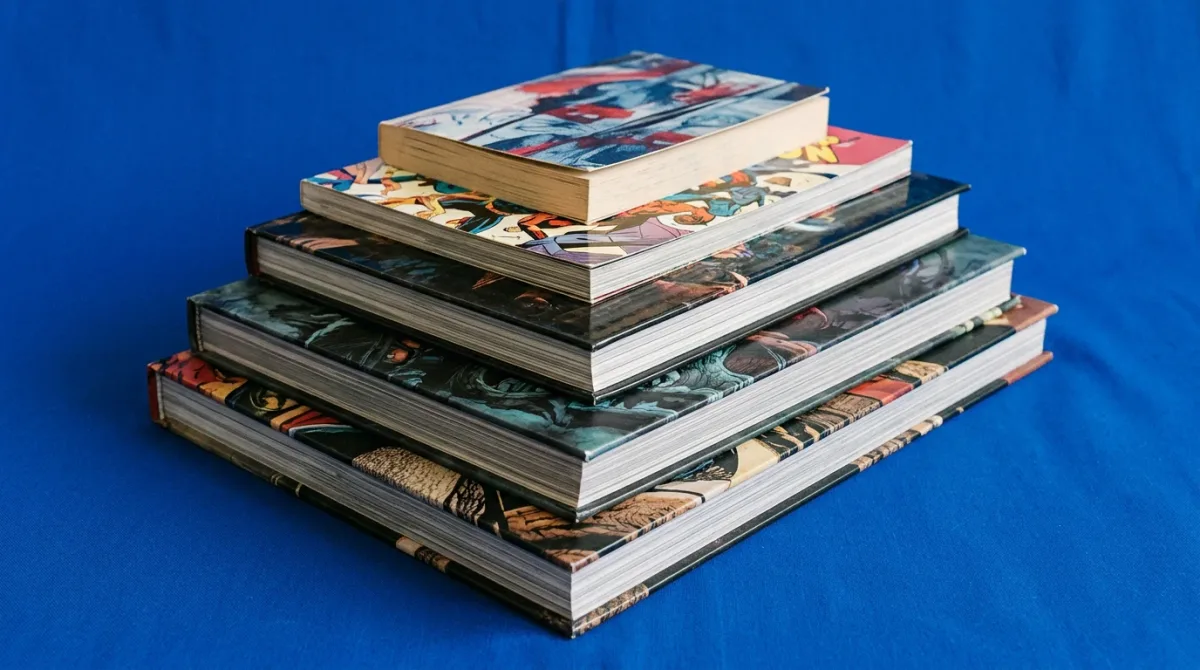
Buy the compendium if you want a long run for the least money per issue, the omnibus if you want the book on your shelf permanently, and a compact paperback if you are only testing whether a story is for you. DC lists its Compact Comics volumes at $9.99 apiece — the cheapest honest way to find out.
What Actually Separates These Formats?
Three things: how much of a run one volume holds, how it is bound, and what that combination costs. A compact paperback carries one self-contained story. A standard trade or Epic Collection carries an era. A compendium or omnibus carries years. Everything else follows from that.
The naming is publisher-specific, not an industry standard, which is why the same word can mean different things on two shelves. What is standard is the relationship: page count drives binding, and binding drives price. A softcover brick and a slipcased hardcover can hold similar amounts of story and still sit fifty dollars apart.
So the useful question is never "which format is best." It is how much of this particular run you actually want in one purchase, and how sure you are that you want it.
How Much Comic Does One Volume Hold?
Anywhere from a single graphic novel to four years of monthly issues. The clearest way to see the spread is to line up real, publisher-listed editions side by side — contents, price, and the date that price was listed, because printings change and cover prices move with them.
| Edition | What one volume holds | Publisher-listed price | Listed date |
|---|---|---|---|
| DC Compact Comics (paperback, 5.5 x 8.5 in) | One self-contained full-colour graphic novel | $9.99 | Line announced November 2023, on sale from June 2024 |
| Marvel Epic Collection (trade paperback) | Avengers Epic Collection: The Gathering — Avengers #367-377, Avengers Annual #23, plus crossover chapters | $49.99 | August 23, 2023 |
| Image compendium (softcover brick) | The Walking Dead: Compendium One — issues #1-48, 1,088 pages | $59.99 | May 6, 2009 |
| Marvel omnibus (hardcover) | Amazing Spider-Man Omnibus Vol. 1 — Amazing Fantasy #15, Amazing Spider-Man #1-38 and Annuals #1-2, plus two more annuals | $99.99 | April 25, 2007 |
| DC Absolute Edition (slipcased hardcover) | The Absolute Sandman Vol. 1 — issues #1-20, 612 pages | $99.99 | October 11, 2006 |
Run the maths and the compendium tier looks unbeatable on volume: Image Comics' release listing puts 48 issues and 1,088 pages in one softcover at the price of roughly a dozen single issues. That is the format doing its job — get the whole story into one hand, cheaply, and let the binding be the compromise.
The omnibus tier is doing something else. Per Marvel's collection listing, the first Amazing Spider-Man omnibus gathers the founding Lee and Ditko run with restored pages, unused covers, essays, pinups, and letters columns. You are paying for the archive, not just the story.
Which Edition Should You Buy First?
The one that costs you least if you turn out not to like it. Curiosity is cheap at $9.99 and expensive at $99.99, and nobody has ever regretted starting small. Work down this order and you will rarely overbuy.
- Start with the cheapest complete version of the story. If the run you want exists as a compact paperback or a single trade, buy that first. One volume. That is the whole commitment.
- If it does not, look for a compendium or an Epic-style collection. These are built for readers who want the run in order without hunting individual volumes.
- Check what the volume actually collects before you buy. Publisher listings spell out the issue numbers; two editions with near-identical covers can hold different chunks of the same run.
- Only step up to omnibus or Absolute after you have read it. The premium tiers are for runs you already know you want to keep.
- Buy the current printing. Older printings of the same title can differ in colour treatment, extras, and trim.
Is the Cheap Paperback Tier a Downgrade?
Not in content. The compact lines reprint the same stories in a smaller trim on cheaper paper, which is a format decision borrowed from mass-market paperbacks and manga rather than a reduced edition. What you give up is size and shelf presence, not chapters.
DC has been explicit about the reasoning. In DC's announcement of the line, SVP and general manager Anne DePies said the "price and sizing is perfect for readers of prose and manga looking to pick up a new-reader-friendly storyline in a self-contained full color graphic novel." The launch slate leaned on titles that stand alone, including Watchmen, All-Star Superman, and Far Sector, rolling out monthly from June 2024.
That is the tell. Publishers use the small format for stories a newcomer can finish without a reading order, which makes it a genuinely good sampling tier rather than a budget consolation prize.
Will the Edition You Want Still Be in Print?
Assume nothing, and check the publisher's page before you plan around it. Paperback lines get reprinted when they sell; premium hardcovers often do not, or return years later with different contents. Print status is the single most volatile fact in collecting.
The compact tier has behaved well so far on that front. DC's own follow-up notes that all ten of the first-year titles went back for second printings, with Watchmen reaching a third printing by September 2024, and the line expanding with fifteen more titles through 2025 — reporting on that second wave lists Kingdom Come, V for Vendetta, and Batman: The Long Halloween among them.
Premium editions are the opposite bet. They are printed to an expected demand and then left alone, which is why the advice to buy the reading copy first and the keepsake second is not just about money.
What Do the Expensive Editions Actually Give You?
Restoration, scale, and archive material. The premium tiers are built for people who already love the run and want the version that treats it like a document. If that is not you yet, the extras are pages you will flip past once.
DC's listing for the first Absolute Sandman volume is a fair example of the tier: 612 pages in a slipcased hardcover, a new colour treatment on the first eighteen issues approved by writer Neil Gaiman, the original series proposal, a character design gallery, the script for issue #19, and reproductions of that issue's original pencil artwork. None of that changes the story. All of it changes the object.
Which is the honest summary of this whole decision. The story is the same at $9.99 and $99.99. What you are actually choosing is how permanent you want the copy to be — so read it cheap, then buy it properly.
For a related business news perspective, read How Comic Book Distribution Works, Per Diamond's Bankruptcy.
For more context, read Owners' Equivalent Rent Carries 25.8% of the CPI.
For more context, read How the Consumer Price Index Is Actually Calculated.
For more context, read How to Bring Textiles Home Without a Customs Surprise.