Nails change constantly with age, and most familiar changes are harmless: vertical ridging and occasional white spots, the two changes people ask about most, are typically benign, per Mayo Clinic guidance, while fingernails grow about 3.5 millimeters per month and toenails about half that speed, per dermatology literature.
This article explains what research and clinical guidance report about common nail changes; it does not diagnose, and nail abnormalities can reflect conditions that need in-person examination.
What do vertical and horizontal ridges mean?
Vertical ridging, fine lines running from cuticle to tip, is a standard feature of aging nails, and clinical reviews compare it with graying hair, gradually developing and rarely significant. Horizontal grooves, called Beau's lines, tell a different story: they form when a systemic event, high fever, significant illness, injury, or certain medications, temporarily pauses nail growth, and because fingernails grow roughly 3.5 millimeters monthly, the groove's position can indicate when the event occurred. A single groove is a footnote; grooves appearing on many nails simultaneously are worth mentioning to a clinician.
Are white spots a calcium deficiency?
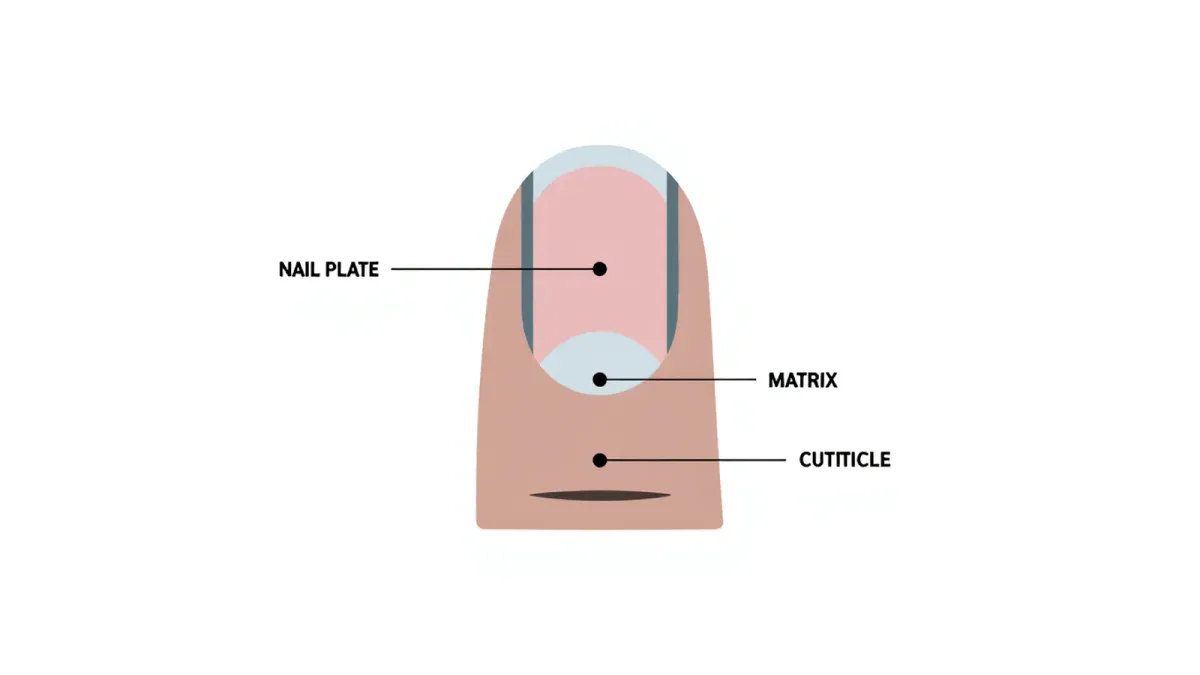
Almost never, per dermatology sources. The small white flecks called punctate leukonychia usually trace to minor trauma to the nail matrix, often from nail biting, manicures, or knocks that went unnoticed. They migrate outward as the nail grows and vanish. Dietary deficiency theories, most often calcium, circulate widely but are not supported in clinical reviews; true deficiency-related nail changes look different, involving the whole nail plate rather than scattered spots.
What causes yellowing and thickening?
Common causes in clinical literature include frequent polish use, which stains the plate, and onychomycosis, fungal infection, which thickens and crumbles nails, particularly toenails. Fungal infection accounts for roughly half of all nail disease, per dermatology estimates, and it affects a majority of people over 70 to some degree. Yellow nail syndrome, a rare condition with slow-growing, fully yellow nails, is associated with respiratory disease and belongs with medical evaluation. Dark-skinned individuals commonly have benign longitudinal brown bands in nails, a normal variant distinct from concerning changes.
When does a dark line or spot in a nail matter?
A single new, widening, or irregular dark streak in one nail, especially without a documented injury, is the change dermatology guidance takes most seriously, because melanoma can arise in the nail unit, and reviews emphasize that early nail melanoma looks deceptively like a bruise. Clues that warrant prompt evaluation include a band that widens toward the tip, involves the skin at the nail's base, or appears in one nail without trauma. A bruised nail from a known injury shows a dark pooled area that grows out; melanoma bands do not move with the plate.
What about splitting, brittleness, and hangnails?
Brittle splitting nails affect a large share of women in surveys, and controlled studies of biotin supplementation show modest improvement in nail thickness at doses around 2.5 milligrams daily, though the trial base is small and older. Behavioral causes dominate in reviews: repeated wet-dry cycling from dishwashing, harsh removers, gel manicure application and removal, and aggressive cuticle trimming. Protective moisturizing of the nail plate and cuticle, and leaving cuticles intact as the seal they are, carry more support than any supplement claim.
Do nails indicate overall health?
Some findings do map to systemic conditions, which is why clinicians examine nails: spoon-shaped nails that hold a droplet can accompany iron deficiency, pale nail beds can reflect anemia, and clubbing, gradual rounding and bulbous widening of the fingertips, is associated with lung and heart disease in clinical reviews. Pitting and oil-drop discoloration associate with psoriasis. These are associations identified through examination patterns, not self-diagnosis tools, and most people seeking answers about one cracked nail fall well outside them.
What does good nail care look like, per guidance?
- Keep nails short and cut straight across with slight rounding, per Mayo Clinic guidance, reducing snagging and ingrowth.
- Wear gloves for prolonged wet work and cleaning chemicals.
- Moisturize hands and cuticles, ideally after washing.
- Limit gel manicures and acetone exposure, both linked in studies to thinning and brittleness.
- Avoid nail-biting and cuticle trimming, which are documented routes to infection.
When should someone see a clinician?
Evaluation is warranted for any new dark band or spot in a single nail, a nail separating from its bed, sudden changes across many nails, pus or spreading redness suggesting infection, nails that thicken or distort quickly, and changes that persist beyond several months of growth. People with diabetes should treat any foot infection, including suspected fungal or bacterial nail infections, as a prompt medical matter, per clinical guidance.
Bottom line
Ridges, white flecks, and slow growth are the ordinary wear of a hard-working structure, and the changes that matter, a dark single-nail band, sudden multi-nail shifts, or signs of infection, are specific enough to recognize. Most nail health is behavior: gloves, moisturizer, and gentler manicure habits outperform anything sold to fix nails from within.