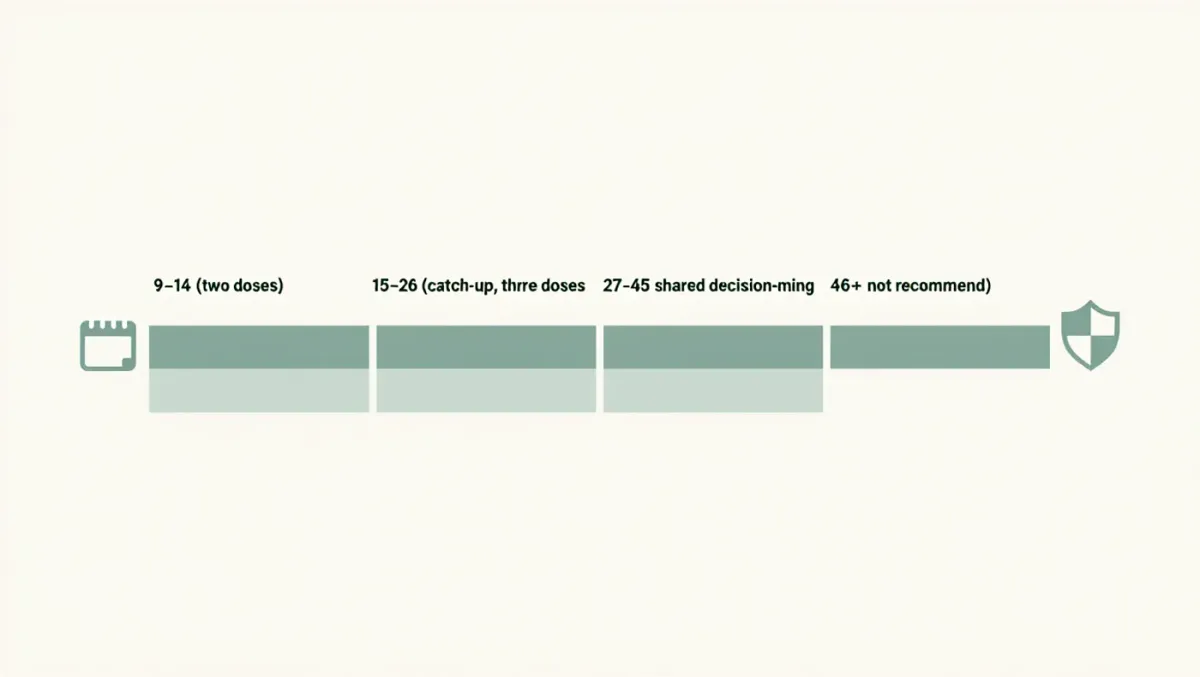

HPV vaccination is best known as an adolescent vaccine, but it remains relevant in adulthood: the CDC's advisory committee, ACIP, recommends catch-up vaccination for all people through age 26 and shared decision-making with a clinician for adults aged 27 through 45, and the vaccine prevents infection with the human papillomavirus types that cause an estimated 36,000 cancer cases in the United States each year, per CDC figures published in 2023. Most sexually active people will acquire at least one HPV infection in their lifetime, and most clear it without ever knowing they had it.
This article explains what the vaccine does, why age shapes the recommendation, how the dosing schedule works for adults, and what the limits are.
What is HPV, and what cancers does it cause?
Human papillomavirus is a family of more than 200 related viruses, transmitted through skin-to-skin sexual contact. Most infections are cleared silently by the immune system within a year or two, but persistent infection with high-risk types, especially HPV 16 and HPV 18, can progress over years to precancerous changes and then cancer. CDC attributes roughly 36,000 US cancer cases annually to HPV, including cervical cancer in women, and cancers of the throat, tongue, tonsils, anus, rectum, penis, vagina, and vulva, with oropharyngeal cancer now the most common HPV-linked cancer in men.
Two widely used vaccines cover the highest-risk types. The vaccine used in the United States since 2016 is Gardasil 9, which protects against nine types, including HPV 16 and 18 together with five additional high-risk types and the two low-risk types that cause most genital warts.
Why does the recommendation change at age 27?
The age logic is about prior exposure, not a new property of the vaccine. Because HPV spreads so efficiently, most people have already encountered several types by their late twenties, so the proportion of infections the vaccine could still prevent shrinks with each additional year of sexual history. ACIP reviewed this exposure data in 2018 when it decided against a blanket recommendation for adults 27 through 45, instead framing vaccination as a shared decision: it may still benefit people with new partners, limited prior exposure, or particular risk factors, while offering less expected benefit to others in the band.
Two further points frame the adult conversation. First, vaccination is preventive, not therapeutic: it does not treat an existing HPV infection or any existing HPV-related disease. Second, the vaccine does not replace screening. Cervical cancer screening remains recommended on its own schedule regardless of vaccination status, since the vaccine does not cover every high-risk type.
How many doses does an adult need?
The schedule depends on age at the first dose. Adults who begin the series before their 15th birthday need two doses, six to 12 months apart. Everyone who starts at 15 or older, including the full adult catch-up range through 26 and the shared-decision range through 45, needs three doses, given at zero, one to two, and six months, per the CDC schedule current as of 2024. If doses are delayed, the series does not restart; the remaining doses are simply completed.
Only two doses are required regardless of start age for people who complete the series before turning 15, and ACIP's guidance also specifies just two doses for certain immunocompetent children beginning at 9. Immunity after completion is long-lasting: follow-up studies cited by CDC show protection holding for more than a decade with no evidence of waning, which is why no booster has been added to the schedule.
How well does it actually prevent cancer?
The cancer-prevention evidence comes through two links. Randomized trials showed near-complete prevention of infection and of HPV-related precancerous lesions caused by vaccine types, with efficacy around 97 to 100 percent against cervical precancer in people who were HPV-naive at vaccination, per trials cited by the FDA and CDC. Population data then confirmed the downstream effect: a 2023 analysis of national surveillance data, cited by CDC, found cervical cancer incidence falling steeply among the first vaccinated cohorts, with women vaccinated at younger ages showing declines of more than 60 percent compared with earlier generations. Oropharyngeal cancer trends are expected to follow with a lag, since these cancers take decades to develop.
What are the side effects?
The profile is mild. CDC's monitoring identifies injection-site pain, redness, and swelling as the most common reactions, along with dizziness shortly after the shot, sometimes with fainting in adolescents and young adults; clinics typically observe recipients briefly for that reason. Fever, nausea, and headache occur less often. Serious allergic reactions are rare, on the order of one per million doses in CDC-cited data. The vaccine contains no live virus and cannot cause HPV infection or any disease it protects against.
When to see a doctor
Adults in the 27-to-45 range considering vaccination should discuss their exposure history and risk factors with a clinician or pharmacist, who can assess whether remaining benefit justifies the three-dose series. Anyone with a moderate or severe acute illness is generally asked to wait until recovery, and pregnant people are advised to delay HPV vaccination until after delivery, per CDC guidance, though exposure during pregnancy has not been associated with harm. Beyond vaccination, cervical cancer screening on the recommended schedule, evaluation of an abnormal Pap or HPV test result, and prompt attention to symptoms such as unexplained bleeding, a persistent sore throat or difficulty swallowing, or a growth in the genital area all belong in a clinician's office rather than in self-care.