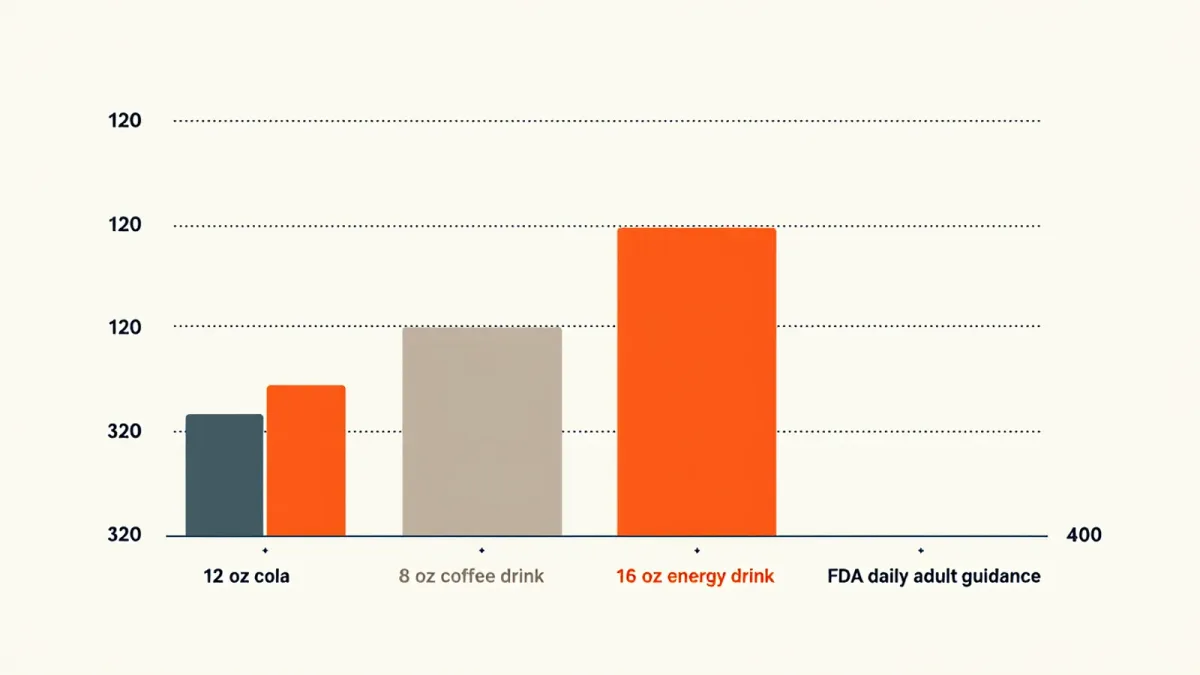

For most healthy adults, up to 400 milligrams of caffeine a day is not associated with negative effects, per the FDA's cited figure, about four or five cups of brewed coffee. Roughly 80 percent of U.S. adults consume caffeine daily, averaging around 135 milligrams, well under that ceiling.
This article explains what the guideline covers and where it does not apply. Newspaper Daily publishes information, not medical advice; people with heart conditions, anxiety disorders, pregnancy, or sleep problems should discuss caffeine with a clinician.
Where does the 400-milligram figure come from?
The number traces to a 2003 systematic review by health scientist Dan French and colleagues, commissioned for Health Canada, which found that adverse effects in adults became consistently detectable above 300 to 400 milligrams per day. Health Canada set 400 milligrams as its adult guideline, and the FDA and the European Food Safety Authority later adopted the same ceiling. The figure describes a population-level threshold for healthy adults, not a personal prescription: individual tolerance varies widely with genetics, particularly variants of the CYP1A2 enzyme that metabolizes caffeine.
How much caffeine is in common drinks?
Caffeine content varies more than most consumers expect, because brewing method, bean, and serving size all shift the total. Typical ranges compiled in USDA food data and FDA consumer updates include:
| Item | Typical serving | Caffeine |
|---|---|---|
| Brewed coffee | 8 oz | 80 to 100 mg |
| Espresso | 1 oz shot | about 63 mg |
| Black tea | 8 oz | 30 to 50 mg |
| Green tea | 8 oz | 25 to 35 mg |
| Cola | 12 oz can | 30 to 40 mg |
| Energy drink | 16 oz | 70 to 200 mg |
A large cafe coffee can exceed 300 milligrams in a single cup, and a 2022 study of retail coffee samples found caffeine concentrations varying as much as ninefold across batches of the same drink.
Who should stay well below the guideline?
Several groups have lower ceilings or are advised to avoid caffeine altogether.
- Pregnant people. The American College of Obstetricians and Gynecologists cites evidence supporting up to 200 milligrams per day during pregnancy, half the general adult ceiling.
- Adolescents. The American Academy of Pediatrics discourages caffeine for children and teens, with about 100 milligrams per day cited as an upper bound for adolescents where consumption occurs.
- People with certain heart conditions. High doses can raise heart rate and blood pressure acutely, and cardiologists often advise caution in arrhythmia patients.
- People with anxiety or insomnia. Caffeine can worsen both, and clinical guidance on insomnia routinely includes reducing intake before midday.
What are the signs of too much?
Per the FDA, symptoms of excess intake include jitteriness, insomnia, headache, rapid heartbeat, nausea, and anxiety. Very large doses, generally above 1,200 milligrams in a short period, can cause seizures and other severe toxicity, which is why the FDA has warned repeatedly about pure powdered caffeine, a product it describes as dangerous because a lethal dose is barely distinguishable in volume from a common serving. Two teenagers died in 2017 after consuming powdered caffeine, and the FDA subsequently moved to restrict its sale.
Does caffeine dehydrate people?
At usual intakes, no. A frequently cited 2000 review by researcher Lawrence Armstrong found no meaningful net fluid loss at caffeine doses typical of daily coffee and tea consumption in habitual drinkers. The diuretic effect shows up mainly at high single doses or in people who rarely consume caffeine.
Is coffee good for health?
The largest observational studies suggest coffee drinkers fare better on several outcomes than non-drinkers, though causation is difficult to isolate. A 2019 meta-analysis in the European Journal of Preventive Cardiology found that moderate coffee consumption was associated with lower all-cause mortality, with filtered coffee showing the strongest benefit, and a 2017 umbrella review in The BMJ reached similar conclusions across dozens of cohorts. Observational associations cannot rule out confounding, and these findings do not establish that adding coffee improves anyone's health.
How long does caffeine last?
The half-life is roughly five hours in healthy adults, though it stretches to double that or more in pregnancy and in people taking certain medications, including some oral contraceptives. Genetics matter as well: slow metabolizers carry caffeine longer and report more sleep disruption at the same dose. A 2013 randomized trial in the Journal of Clinical Sleep Medicine found that 400 milligrams taken even six hours before bed cut objective sleep time by more than an hour.
When to see a doctor
Palpitations, chest discomfort, persistent tremor, severe anxiety, or chronic insomnia that improves when caffeine stops all warrant a medical conversation. Anyone who needs increasing doses to feel normal, experiences withdrawal headaches that disrupt the day, or finds caffeine masking fatigue that should be investigated should speak with a clinician. Sudden complete cessation commonly causes headaches and irritability for several days, so gradual tapering is the approach most often suggested in clinical guidance.