
For overall health, walking appears to close the gap with running more than most people assume: a frequently cited analysis of more than 33,000 runners and nearly 16,000 walkers by Williams and Thompson, published in 2013, found that when energy expenditure was matched, both activities reduced the risks of high blood pressure, high cholesterol, diabetes, and heart disease by similar amounts.
Why the comparison comes down to energy expenditure
Running burns more energy per minute than walking — running a mile costs roughly twice the energy of walking the same distance in common conversion schemes, per research on the energetic differences between the two gaits. That fact drives most of the headline differences. A 30-minute run typically spends more energy than a 30-minute walk, so comparing the two by time alone measures intensity, not activity. Comparing them by total energy spent asks the fairer question: does running do something to the body that walking cannot at the same energy cost?
Per the evidence available, the answer is mostly no. The Williams and Thompson analysis found dose-matched walking performed comparably for the major cardiometabolic risk factors, and in some comparisons the walking cohort showed equal or slightly larger risk reductions for the same measured energy expenditure. Meta-analytic work comparing walking interventions with more vigorous exercise on blood pressure, cholesterol, and diabetes markers has reached a similar conclusion: at matched energy expenditure, health-marker changes are similar.
What the mortality research shows
Large observational cohorts associate both activities with lower all-cause mortality. Research published in 2020 drawing on national survey data found that running was associated with lower all-cause and cardiovascular mortality at even modest weekly doses — as little as one session or 50 minutes per week — and found no evidence that higher volumes added large further benefit. Walking has its own extensive literature: analyses of hundreds of thousands of adults, including a 2023 study in JAMA Network Open tracking adults over 50, associated step-based measures from walking with progressively lower mortality up to roughly 9,000 to 10,000 steps per day, with benefits appearing well below those levels.
One nuance deserves care: these are observational findings, adjusted statistically but still vulnerable to confounding — people who walk or run differ from those who do not in ways studies cannot fully remove. The literature therefore supports an association between both activities and lower mortality risk, not a proof of causation, and not a demonstrated superiority of one over the other.
Where running holds an advantage
Time efficiency leads the list. Reaching a given energy expenditure takes roughly half the time running. For cardiovascular fitness specifically, higher-intensity work improves VO2max more per unit of time, consistent with the broader interval-training literature. Bone density is another plausible edge: running's impact loading delivers stronger osteogenic stimulus per minute than walking, and studies associate regular running with higher hip and spine bone mineral density. Runners also spend more time at ventilatory thresholds that challenge the aerobic system in ways walking rarely reaches for unfit-to-fit adults.
Where walking holds an advantage
Injury risk inverts the trade. Running's impact forces, several times body weight per stride, accumulate into higher injury rates: reviews of running populations report roughly 20 to 80 percent of runners injured over a year, with lower-limb overuse conditions dominating. Walking injuries occur but at far lower rates, and reviews of walking programs report excellent adherence, which matters because consistency — not intensity — is what accumulates into long-term risk reduction.
Walking also fits more lives. No shower logistics, no special facilities, easier conversation, lower perceived exertion, and evidence from step-intervention research suggesting even short bouts accumulate meaningfully across a day. For adults with obesity, joint disease, or long inactivity, walking is often the only activity that survives contact with real routines, and its mortality literature supports exactly that population-level usefulness.
Head-to-head at a glance
| Outcome | Walking | Running |
|---|---|---|
| Cardiometabolic risk factors | Similar at matched energy expenditure | Similar at matched energy expenditure |
| VO2max improvement | Modest at usual paces | Larger per time |
| Bone density stimulus | Lower per minute | Higher impact loading |
| Injury rate | Low | Substantially higher |
| Time to burn equal energy | Roughly double | Half |
| Adherence in trials | High | Lower |
Is a mixed approach reasonable?
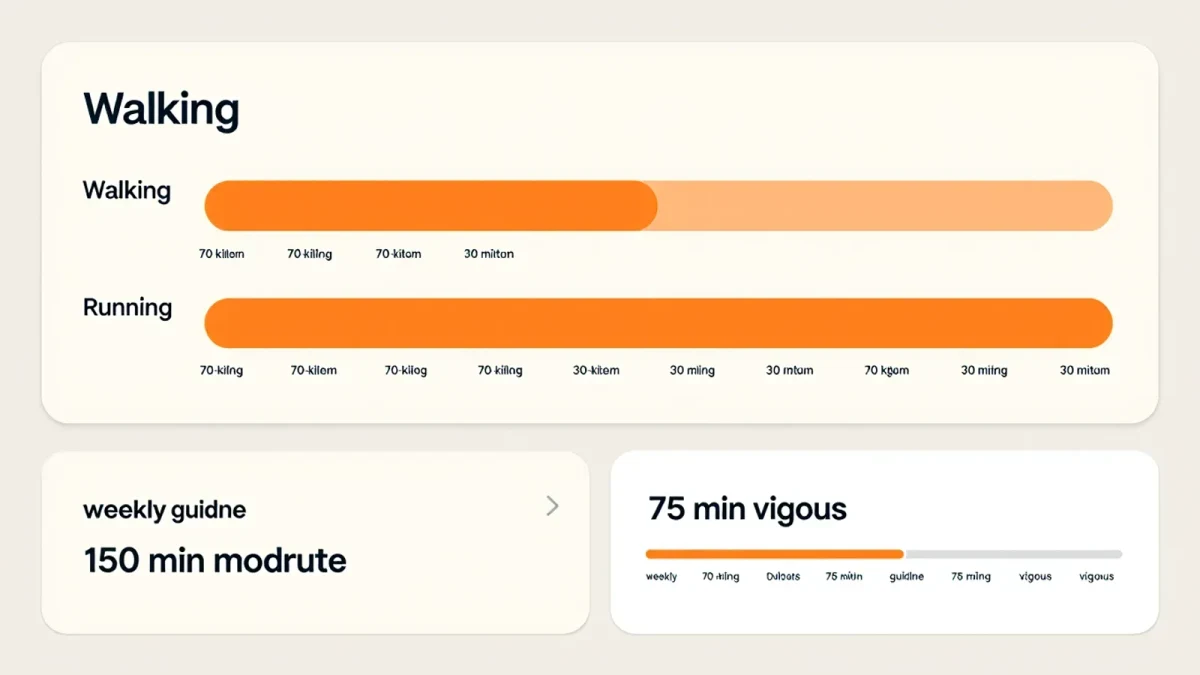
The evidence does not force a choice, and most programs need not choose. A pattern common in practice — walking as the daily base, plus one or two running or brisk sessions weekly — captures running's fitness and bone benefits while keeping injury exposure low. Walk-run intervals, in which running bouts are embedded in walks, are a widely used bridge for beginners and returning exercisers, though specific injury-prevention claims for the method rest more on coaching experience than on trial data. Federal guidance counts both toward the 150-minute weekly moderate-activity target, per the CDC's guidance, with running counted as vigorous and qualifying at half the duration.
Does speed of walking matter?
It does, and the step-count literature sharpens the point. Analyses that separated total steps from cadence found that, at any given daily step total, faster walkers showed lower mortality risk than slower walkers — an association its authors treated as consistent, though observational, evidence that intensity carries additional information beyond volume. Cadence-based guidance that emerged from this work describes roughly 100 steps per minute as a practical moderate-intensity marker for adults, a threshold that turns an ordinary walk into the activity the guidelines intend. For slower walkers, incline and load — hills, stairs, a weighted pack — raise intensity without requiring faster turnover, though evidence specific to weighted walking remains thinner than for plain brisk walking.
How should a beginner choose between them?
Three practical filters resolve most cases. Joint and injury history favors walking first, with running introduced gradually if desired. Time budget favors running, which buys the same energy expenditure in half the hours. Preference and track record matter most of all: the activity a person actually repeats is the one that delivers the mortality benefits the cohorts describe, and adherence research consistently shows walking survives busy weeks better. A walk-to-run progression over eight to twelve weeks — short run bouts inside brisk walks, lengthened gradually — suits many beginners who want running's efficiency without its early injury exposure.
When to see a doctor
Clinician consultation is the standard recommendation before starting or intensifying either activity for adults with known heart disease, chest pain during exertion, uncontrolled blood pressure, diabetes with complications, or a long period of inactivity. During activity itself, chest pressure, faintness, or breathing that does not settle within minutes of stopping warrant medical assessment. Persistent joint pain that alters gait, localized bone tenderness, or foot numbness in walkers or runners deserves evaluation before training continues, since both activities reward early attention to mechanical problems far more than they forgive late attention.