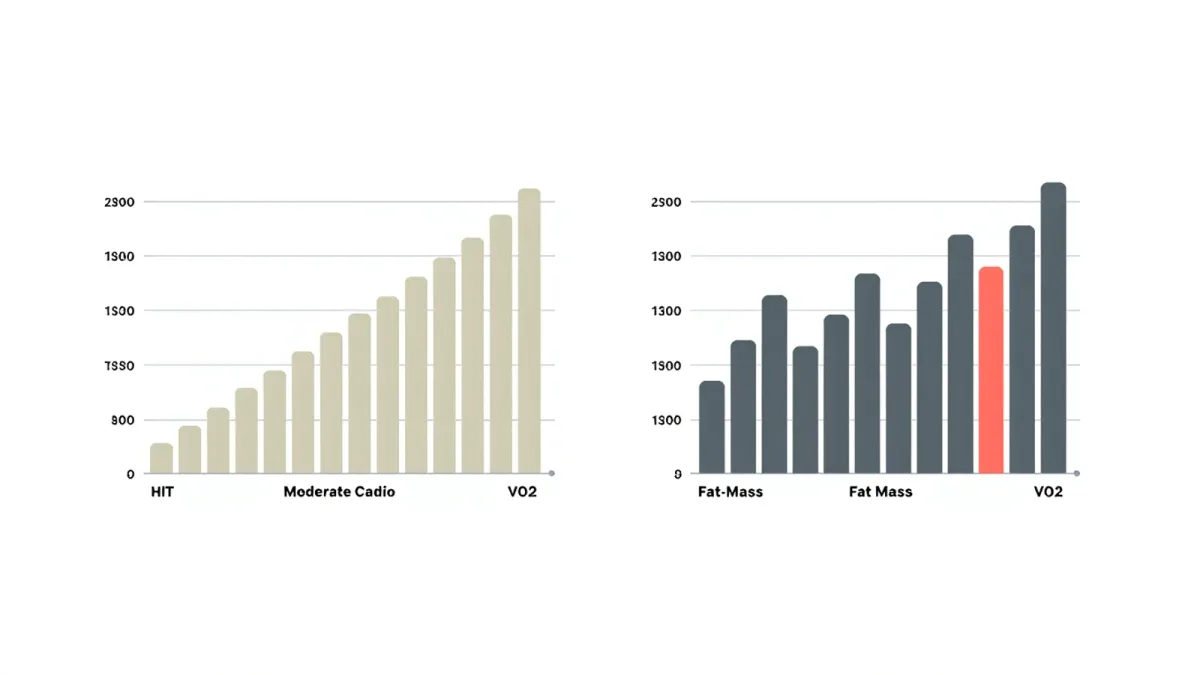

Per minute of actual effort, high-intensity interval training improves cardiorespiratory fitness faster: a widely cited 2019 meta-analysis of randomized trials found HIIT raised VO2max about twice as much as moderate-intensity continuous training when time commitments were matched. For total health outcomes over months and years, however, the evidence is far less lopsided, and the best choice depends on goals, schedule, and recovery capacity.
What counts as HIIT, and what counts as moderate?
High-intensity interval training alternates short bursts of near-maximal or maximal effort with recovery periods. Classic protocols include 4 repetitions of 4 minutes hard with 3 minutes easy, or 30 seconds all-out sprints with several minutes of recovery. Perceived effort during work intervals typically sits at 8 or 9 on a 10-point scale, where speaking more than a few words is impossible.
Moderate-intensity continuous training is steady-state work that can be sustained for 30 minutes or more: brisk walking, easy jogging, steady cycling. Breathing is elevated but conversation holds, and effort usually sits between 4 and 6 of 10. The CDC defines moderate activity as roughly 3 to 6 times the energy cost of rest, per the CDC's definition of moderate intensity as 3 to 6 times resting energy cost, and its guidelines ask adults for at least 150 minutes of it per week.
What the research found on fitness
The clearest scientific difference is VO2max — the body's maximum capacity to use oxygen, and in observational studies one of the stronger predictors of long-term health. Multiple meta-analyses of randomized trials, including a frequently cited 2019 analysis pooling 36 trials, found HIIT produced larger VO2max gains than moderate continuous training over comparable study lengths, and a 2024 network meta-analysis in the British Journal of Sports Medicine reported that HIIT and sprint interval training outperformed moderate training for VO2max improvements, with larger apparent benefits at longer study durations. When total training time is matched minute for minute, some analyses find the advantage narrows or disappears, which suggests part of HIIT's reputation reflects protocol design rather than unique physiology.
Blood pressure, insulin sensitivity, and body composition respond to both formats. Trials suggest HIIT reduces blood pressure comparably to moderate training, and 2022 meta-analyses found no meaningful difference in fat loss between the two when energy expenditure was similar — a notable finding given the marketing claims around interval work and calorie burn.
Where moderate cardio holds advantages
Volume is the quiet variable behind many long-term outcomes. Large observational cohorts associate total weekly activity — not any particular format — with lower cardiovascular and all-cause mortality risk, and moderate intensity is simply easier to accumulate: a 45-minute zone 2 ride is repeatable several times a week, while maximal intervals leave fatigue that limits what comes next. Adherence research points the same way; studies of exercise programs consistently find dropout higher as intensity rises, and surveys of preference reliably favor moderate over very hard effort in the general population.
Moderate cardio also carries lower acute risk. Intense exertion transiently raises the short-term risk of cardiac events in susceptible individuals, and reviews of adverse events in HIIT trials note that most excluded exactly the populations most likely to be exercising clinically — people with existing cardiovascular disease — which complicates blanket safety claims.
Where HIIT holds advantages
Time efficiency is real. A session including warm-up, four 4-minute intervals, and cool-down fits inside 30 minutes and produces fitness adaptations that trials measure as equal or superior to longer steady sessions. For people whose only barrier is time — and time is the most commonly reported barrier to exercise — that efficiency has practical value the raw physiology understates. HIIT may also counteract the decline in mitochondrial function associated with aging more directly: a 2017 randomized trial at the Mayo Clinic found high-intensity interval training improved mitochondrial respiration in older adults more than resistance or combined training did, a finding its authors described as suggestive rather than definitive.
Head-to-head summary
| Outcome | HIIT | Moderate cardio |
|---|---|---|
| VO2max improvement | Larger gains, faster (multiple meta-analyses) | Slower, similar when time is matched |
| Blood pressure | Comparable reductions | Comparable reductions |
| Fat loss | Similar at matched energy expenditure | Similar at matched energy expenditure |
| Weekly volume potential | Limited by fatigue | High; repeatable most days |
| Adherence and preference | Lower in general populations | Higher |
| Acute injury and cardiac risk | Higher transient risk | Lower |
Can the two be combined?
Most evidence-based programs do exactly that. A workable pattern for a generally healthy adult is two to three moderate sessions supporting the 150-minute guideline, one or two interval sessions where fitness gains are the priority, and strength training on nonconsecutive days. Hard intervals recover best with easy days around them; stacking intervals onto depleted legs raises both injury risk and the chance the work intervals fall below target intensity. Training history matters — beginners typically spend 8 to 12 weeks building an aerobic base before maximal intervals, a sequencing many coaches recommend to reduce strain on tendons and joints that adapt more slowly than the cardiovascular system.
Which format suits which goal?
The goals point in different directions. For raising VO2max on a tight schedule, HIIT has the stronger trial evidence. For general health mortality risk, total weekly volume matters most, which favors moderate work that is easy to repeat. For fat loss, the format appears nearly irrelevant when energy expenditure matches. For blood pressure and blood sugar, both qualify under the same guideline umbrella. For people who dislike intense effort — a substantial majority in preference surveys — the answer is the one that happens at all: moderate cardio performed consistently outperforms intense cardio abandoned by week six.
Does soreness differ between formats?
It tends to, and the pattern is consistent with the risk discussion above. Maximal intervals — particularly sprinting or jumping variations — load tendons and muscle eccentrically at high force, and studies of delayed-onset muscle soreness report larger and longer-lasting soreness responses after novel high-intensity work than after matched moderate sessions. That matters practically: soreness reduces the quality of subsequent training days and, in beginners, predicts dropout. Moderate sessions rarely produce more than mild transient fatigue once the body has adapted, which is one reason they tolerate high weekly frequency so well.
When to see a doctor
Medical consultation is the standard recommendation before starting HIIT for anyone with known cardiovascular disease, chest pain during exertion, uncontrolled hypertension, diabetes with complications, or a long period of inactivity behind them. During training itself, chest pressure, radiating arm or jaw pain, faintness, or breathing that fails to recover within a few minutes of stopping are reasons to stop and seek medical assessment rather than resume. Pregnant athletes and people returning from illness or injury should follow clinician-approved progressions rather than self-prescribing maximal intervals.