Exercise is among the better-supported treatments for chronic lower back pain: a large 2016 randomized trial published in the Annals of Internal Medicine found a weekly yoga class reduced back-related dysfunction in predominantly low-income, racially diverse patients as effectively as physical therapy, and clinical guidelines consistently place structured exercise above passive treatments for long-standing pain.
What does the research say about exercise for back pain?
The evidence base divides by duration. For acute back pain — episodes of days to weeks — reviews found exercise adds little beyond staying active and letting natural resolution occur; most uncomplicated episodes improve within several weeks regardless of intervention. For chronic pain, defined as persisting beyond 12 weeks, the picture changes: a 2016 systematic review in JAMA Internal Medicine found exercise therapy produced small to moderate reductions in pain and improvements in function, and major clinical guidelines, including 2018 recommendations published in the Lancet by an international working group, advise staying active, avoiding bed rest, and using structured exercise rather than rest, opioids, or imaging-first pathways for most cases.
Which exercises work best is a genuinely contested question. Trials comparing specific approaches — stabilization programs, general strengthening, walking, yoga, tai chi, motor control training — generally find most reasonable exercise approaches outperform no treatment, with differences between them smaller than their marketing suggests. A frequently cited exception: a 2022 systematic review and network meta-analysis in the BMJ found that approaches combining motor control training with stretching and aerobic activity, and tai chi, yoga, and pilates-style programs, produced larger short-term improvements in chronic pain intensity than minimal treatments.
Which core exercises have the strongest support?
Clinical programs converge on a short list, each with trial history behind it:
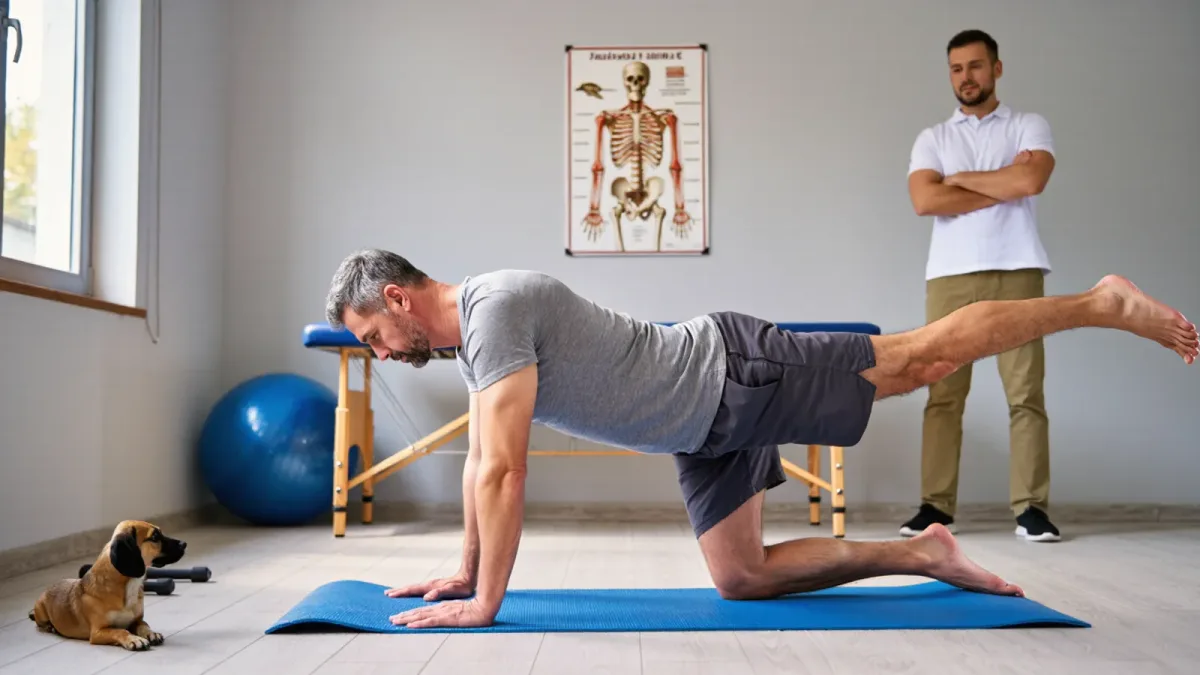
- Bird-dog — extending opposite arm and leg from hands and knees, training trunk control without spinal loading; a staple of motor-control research protocols.
- Side plank and front plank variations — building endurance in trunk musculature with the spine in a neutral position; low-load versions on knees suit early stages.
- Dead bug — slow limb movement while the trunk resists extension, teaching control during the transitions where pain often flares.
- Glute bridge — hip extension strength shifts load away from the lumbar region during lifting tasks; hip extensor weakness appears in many chronic pain populations studied.
- Walking and graded aerobic activity — walking trials in chronic back pain populations report meaningful functional improvement, and guidelines treat aerobic activity as part of the core prescription, not an alternative to it.
Repetition schemes in clinical studies are modest: holds of 8 to 10 seconds, sets of 8 to 12 repetitions, performed most days of the week, progressed over 8 to 12 weeks. The consistency demand is the real finding across studies — benefits tracked adherence closely in the trials that measured it.
What about the McGill big three?
Spine biomechanics researcher Stuart McGill popularized a trio — modified curl-up, side plank, bird-dog — chosen to build trunk endurance while minimizing spinal flexion loading, and the approach is widely used clinically. Direct randomized trials of the trio as a package are scarce; support comes largely from biomechanical rationale, clinical experience, and the broader finding that trunk stabilization reduces chronic pain modestly. Reviews comparing stabilization exercise with general exercise found no large advantage for either, so the big three are best understood as a well-designed example of the category rather than a proven superior method.
Are sit-ups and back stretches safe?
Common defaults deserve caution here. Repeated full sit-ups load the lumbar spine in flexion with substantial compressive force in biomechanical studies, and most modern clinical programs have replaced them with the curl-up's partial range. Conversely, repeatedly pulling the knees to the chest or touching toes for pain relief produces short-lived comfort for some and provokes symptoms in others; flexion-intolerant pain — worse with bending — is a recognized pattern that such stretches aggravate. Research on classification-based treatment found matching exercise direction to the symptom pattern outperformed one-size-fits-all stretching, which is the strongest argument for professional assessment before self-prescribing.
How long until improvement?
Trials of exercise therapy in chronic back pain typically measure first meaningful improvements at 4 to 6 weeks, with peak benefit around 8 to 12 weeks. Relapses are the norm rather than the exception over a year, and the trials with the strongest long-term results are those that continued some form of exercise after the supervised phase ended — a pattern consistent with exercise acting as ongoing management rather than a curative course.
How should a beginner start safely?
The clinical trials started patients slowly, and the pattern transfers to home practice. A workable first two weeks uses only the low-load versions: planks from the knees, bird-dog without weights, dead bug with small ranges, five to eight repetitions per set, and stopping well short of strain. Pain during an exercise is a stop signal; discomfort that lingers into the next morning suggests the previous session overshot. Sessions four to six days weekly sound demanding but each lasts 15 to 20 minutes, and daily low-dose practice is exactly what several stabilization trials used. From week three, holds lengthen, repetitions climb, and a walking component — starting at 10 to 15 minutes — joins the program. Adding resistance, typically in month two or three, precedes any return to heavier lifting patterns such as deadlifts, and that return is best supervised the first time by a physical therapist or trainer familiar with back pain, per the standard clinical-rehabilitation sequencing.
Does core training prevent back pain in the first place?
The prevention evidence is weaker than the treatment evidence, and honest summaries say so. Reviews of workplace and sports interventions found that exercise programs reduced the risk of future lower back pain episodes modestly — one 2019 review of prevention trials reported exercise alone reduced the risk of a new episode by roughly a quarter to a third — while education, belts, and insoles performed poorly by comparison. Whether core-specific training prevents better than general strength training remains unsettled; the largest analyses group all exercise together. What prevention research does agree on is the modifiable context around pain: heavy or awkward occupational lifting, prolonged sitting without breaks, smoking, and psychological distress all associate with higher risk, and trials suggest exercise plus education about staying active outperforms exercise alone for workers at risk.
When to see a doctor
Certain features separate ordinary back pain from situations requiring prompt medical assessment: pain following significant trauma, numbness in the groin or inner thighs, loss of bladder or bowel control, progressive leg weakness, fever alongside back pain, a history of cancer, or unexplained weight loss. Any of these warrants urgent clinical evaluation. Outside them, pain that persists beyond several weeks despite staying active, or that radiates below the knee with persistent leg symptoms, deserves a routine clinical visit before an exercise program intensifies.