A single adjustable pair of dumbbells is enough equipment for a complete strength program: research on resistance training shows that programs built on free weights, two to three sessions weekly per the CDC's muscle-strengthening guideline, produce significant strength and muscle gains in untrained adults, and dumbbells cover every movement pattern such programs require.
Which dumbbells suit home training?
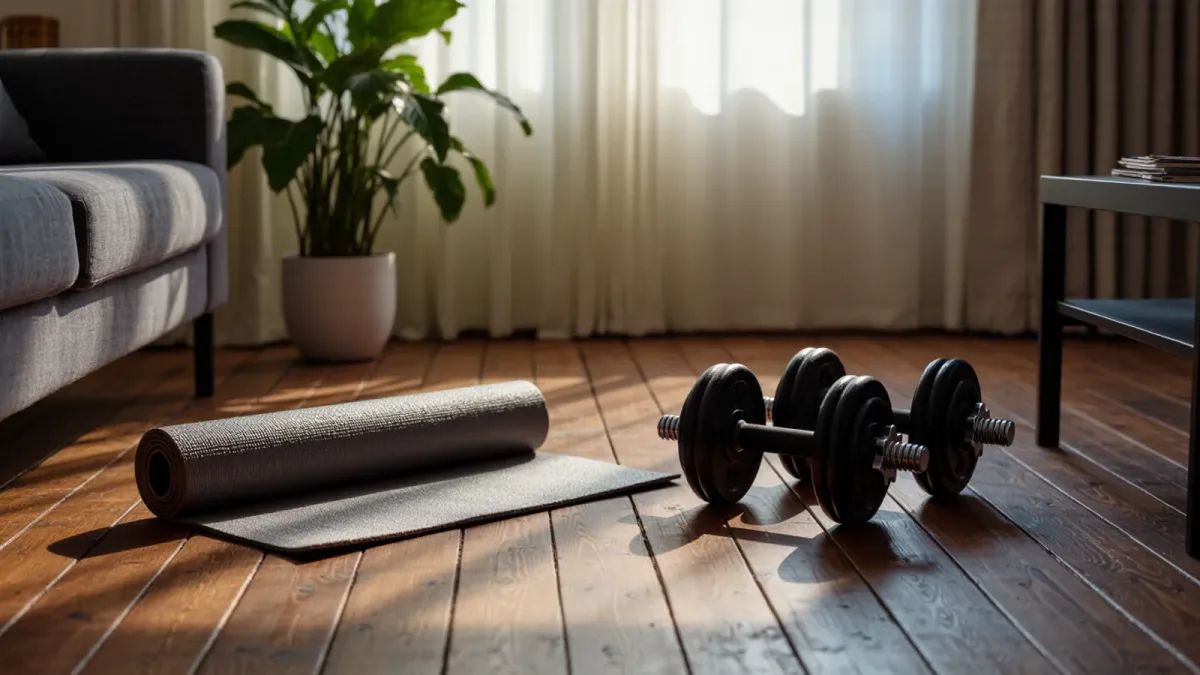
Adjustable dumbbells that change weight in 2 to 5 kilogram increments suit most home programs better than fixed pairs, because progression — the requirement that loads keep rising — would otherwise demand a small warehouse of fixed weights. A workable starting range for most adults is roughly 5 to 25 kilograms per hand; beginners can start lighter for pressing movements and progress within months. Fixed pairs remain fine for households already owning a few, with body-weight exercises filling the resistance gap while capacity grows. Quality matters at the joints more than at the handle: knurled or textured grips reduce the slipping that forces grip to fail before the target muscle does.
What movement patterns should the program cover?
Federal guidance asks that sessions work all major muscle groups, and practical programs translate that into six patterns rather than a long exercise list:
- Squat — goblet squats, dumbbell front squats, split squats for the legs and hips.
- Hinge — Romanian deadlifts, single-leg deadlifts for hamstrings, glutes, and back.
- Horizontal push — floor presses and dumbbell bench presses for chest and triceps.
- Horizontal pull — one-arm dumbbell rows, renegade-row setups for the upper back.
- Vertical push and pull — overhead presses; pulls substitute with rows done high-to-low if no pull-up bar exists.
- Carry and core — farmer carries, suitcase carries, weighted planks for trunk and grip.
Six patterns keep programming honest: whatever the workout, each pattern appears at least twice across the week. Exercise variety matters less than load progression and consistency, a point trial after trial returns.
What does a first month look like?
A three-day full-body structure matches the evidence base well — each muscle trained three times weekly with a rest day between sessions:
| Day | Focus | Example session |
|---|---|---|
| Mon | Full body A | Goblet squat 3x8, floor press 3x8, one-arm row 3x10 each, carry 3x30 m |
| Tue | Rest or walk | Easy movement only |
| Wed | Full body B | Romanian deadlift 3x8, overhead press 3x8, split squat 3x8 each, plank |
| Thu | Rest or walk | Easy movement only |
| Fri | Full body A | Repeat Monday, one repetition more per set |
Repetition targets between 6 and 12 suit most home lifters, with sets leaving one or two repetitions in reserve. When the top of a repetition range becomes comfortable, weight increases — a small jump, then the repetition count rebuilds. Research on progressive overload identifies this slow cycling, not soreness or novelty, as the driver of long-term gains.
How is progress tracked without a gym?
A notebook or phone note suffices: exercise, weight, repetitions per set. Trials of self-monitored training find tracking alone improves adherence, and the log makes the progression rule mechanical rather than motivational — check last week, beat it by one repetition or one increment. Plateaus lasting three or more sessions on the same weight call for a temporary reduction, either fewer sets for a week or a lighter load for higher repetitions, before resuming the climb; this fatigue-management pattern recurs in the training-science literature under names like deloading.
What are the common home-training mistakes?
Four recur. First, load that never changes: identical workouts repeated for months maintain rather than build, per the progression research. Second, rushing range of motion — partial squats and half-row pulls trade results for ease, and full-range versions recruit more muscle per repetition. Third, ignoring lower body, the pattern in many home routines built around presses and curls; the leg patterns above carry disproportionate value for daily function. Fourth, no warm-up: two minutes of easy movement plus one light set per pattern prevents most of the strains home lifters report.
When to see a doctor
Medical consultation is the standard recommendation before beginning strength training for adults with heart disease, uncontrolled blood pressure, hernias, significant joint disease, or recent surgery, and during pregnancy. Sharp joint pain during a lift, pain persisting more than several days after a session, numbness or tingling down an arm or leg, or dizziness during exertion all warrant professional assessment rather than training through. Persistent lower back pain provoked by hinging movements deserves a physical therapist's review of technique before loads increase.