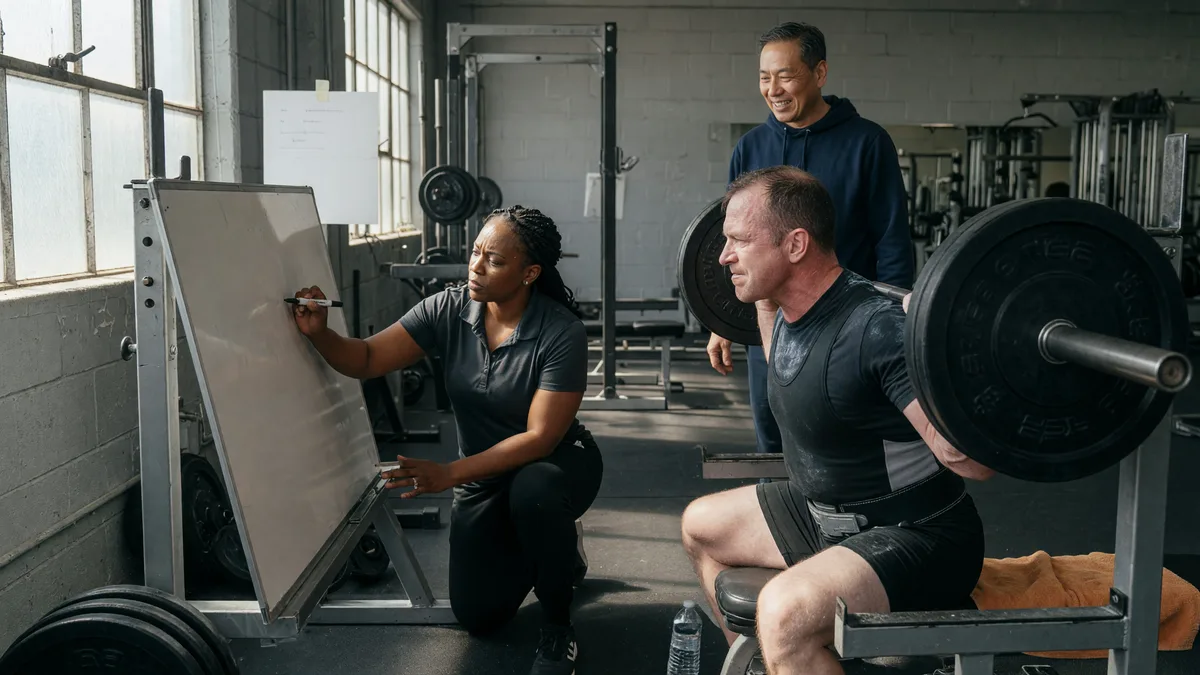

Muscle responds to resistance training well past midlife: adults in their 50s, 60s, and 70s who lift weights two or more days a week gain measurable strength and, per the CDC's Physical Activity Guidelines for Americans, should aim for muscle-strengthening work on at least 2 days each week alongside about 150 minutes of moderate aerobic activity. Age changes how quickly those gains arrive, but it does not remove the capacity to make them.
What happens to muscle after 50?
From roughly the fourth decade onward, adults lose muscle mass gradually, a process researchers call sarcopenia when it reaches clinically meaningful levels. Muscle strength tends to decline faster than muscle size, and power — the ability to move quickly against resistance — often falls first. That matters in daily life because climbing stairs, rising from a chair, and catching balance all depend on fast force production.
Loss is not uniform. Studies suggest physically inactive adults lose muscle considerably faster than active ones, and bed rest or illness can accelerate decline dramatically. The encouraging part of the evidence is that the loss is modifiable: skeletal muscle in older adults retains the ability to add protein and grow in response to loading, a finding repeated across decades of research on resistance training in aging populations.
What the research shows
The core finding is consistent: older adults who undertake progressive resistance training get stronger, and the effect is reliable enough that it appears in nearly every systematic review of the topic. A widely cited 2019 position statement from international sarcopenia researchers concluded that resistance exercise is the most effective available strategy for maintaining muscle mass and function with age.
Trials in adults over 60 have found that structured programs lasting 12 weeks or longer produce meaningful improvements in leg strength, chair-stand performance, and walking speed. A 2022 meta-analysis of randomized trials in older adults found that resistance training improved muscle strength and physical function compared with control conditions, with benefits appearing even at relatively modest training volumes. Some research also associates resistance training with better bone mineral density in older adults, particularly at loaded sites such as the hip and spine, though observational evidence on fracture risk is mixed.
Benefits extend beyond muscle. Observational studies associate greater muscle strength in midlife with lower all-cause mortality over long follow-up periods, and randomized trials suggest resistance training can improve sleep quality, mood, and glycemic control in older populations. These associations are not proof of causation, but they add to the case that strength work is worth prioritizing after 50.
How often and how hard?
Federal guidance is the clearest starting point: at least 2 muscle-strengthening sessions per week, covering the major muscle groups. Research on dose suggests several practical principles:
- Two to three sessions per week on nonconsecutive days fits most evidence-based programs and allows recovery between sessions.
- Intensity matters. Trials that produce strength gains in older adults typically use loads challenging enough that the last repetitions of a set feel difficult — commonly described as working at a level of 6 to 8 on a 10-point effort scale.
- Progressive overload — gradually adding weight, repetitions, or sets over time — distinguishes programs that keep working from those that plateau.
- Compound movements such as squats to a chair, presses, rows, and deadlift patterns train multiple muscle groups efficiently and rehearse movements used in daily life.
- Balance and power elements — for example, controlled sit-to-stand work at moderate speed — address the fast-force capacity that declines earliest.
Beginners often start with one set of 8 to 12 repetitions per exercise and add sets as tolerance improves. Studies suggest even single-set programs produce meaningful strength gains in untrained older adults, which lowers the barrier to starting considerably.
What about protein?
Muscle growth requires raw material. Research on protein intake in older adults suggests needs may be modestly higher than in younger people, with several expert groups suggesting roughly 1.0 to 1.2 grams of protein per kilogram of body weight per day for healthy older adults, and some trials finding that protein intake near training sessions supports muscle protein synthesis. Evidence on timing is weaker than evidence on total daily intake, so the practical takeaway is that total protein across the day deserves more attention than precise scheduling.
Does it require a gym membership?
No. Trials of home-based resistance programs using resistance bands, body weight, and light dumbbells have found strength and function improvements in older adults comparable to those seen with machines, at least over the 12- to 24-week windows most studies measure. Body weight options such as chair squats, wall push-ups, step-ups, and heel raises cost nothing and scale in difficulty easily: a chair squat becomes a partial squat, then a full squat, then a squat holding a loaded backpack. Resistance bands add adjustable load for rows, presses, and pull-aparts, and cost far less than a membership. The trade-off is progression: research on long-term adaptation suggests loads eventually need to become challenging enough to keep stimulating muscle, which at home usually means heavier dumbbells, bands with higher resistance, or added weight in a backpack.
Should aerobic exercise be added?
The guidelines treat strength and aerobic work as complementary rather than competing, and the evidence backs the pairing. Large observational cohorts associate the combination of moderate aerobic activity and muscle-strengthening activity with lower all-cause mortality than either alone. In practice, many programs alternate them across the week — two strength sessions plus walking, cycling, or swimming on other days — which also distributes recovery demands. Adults already doing substantial cardio may simply need to add two short strength sessions rather than restructure everything, and research suggests even 20-minute strength sessions produce measurable benefits in previously untrained older adults.
Is it safe to start lifting at 60 or 70?
For most healthy adults, yes, and trials routinely enroll participants in their 60s and 70s with good results and low rates of adverse events when programs are supervised or well-designed. Risks that do appear in the literature are mostly musculoskeletal strains from progressing too quickly, rather than dangerous cardiovascular events. Common-sense screening — and medical clearance for people with heart disease, uncontrolled blood pressure, significant joint disease, or recent surgery — is the standard recommendation. Starting with lighter loads, learning technique, and increasing difficulty gradually covers most of the risk that remains.
How long until results appear?
Neural adaptations arrive first. Many trials measure noticeable strength improvements within 4 to 6 weeks, well before visible muscle growth becomes apparent, because early gains come largely from improved coordination and recruitment. Visible changes in muscle size typically require 12 weeks or more of consistent training. Research also suggests strength losses during a break occur slowly, so occasional interruptions do not erase months of work.
When to see a doctor
A clinician should evaluate new chest pain, dizziness, or unusual shortness of breath during activity before training continues. Rapid unexplained muscle loss, weakness on one side of the body, or new back or joint pain that persists more than a few days warrants medical assessment rather than training through it. People with osteoporosis may need specific guidance on loaded movements and spinal flexion, and anyone recovering from surgery or cardiac events should follow a clinician-approved progression before resuming or beginning resistance training.