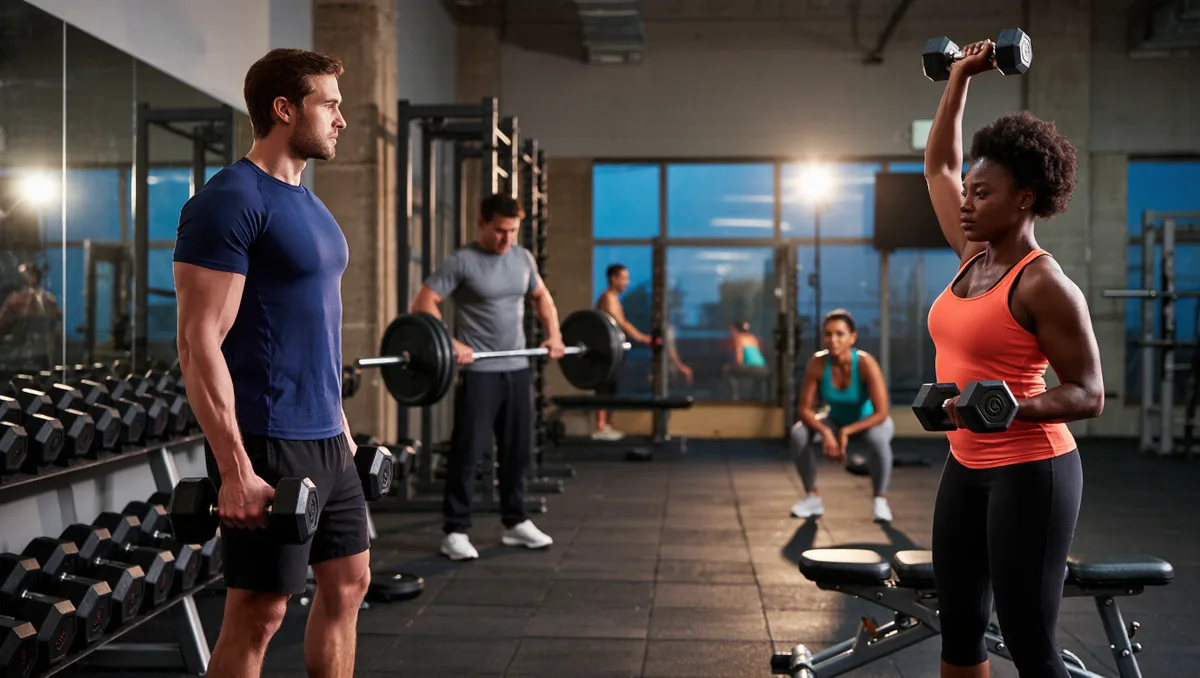
Chest workouts with dumbbells are pressing and flye movements done with a pair of hand-held weights instead of a barbell or a machine. They train the pectoral muscles — the large muscles across the front of the chest — along with the shoulders and the backs of the arms. They suit every skill level because the weights can be changed one side at a time and the range of motion can be shortened or lengthened.
The chest itself is a defined anatomical region. Wikipedia's anatomy entry on the thorax describes the chest as the part of the body between the neck and the abdomen, containing the heart and lungs and protected by the rib cage, spine, and shoulder girdle, with the major and minor pectoral muscles sitting at the front. That structure explains why dumbbell work is useful: each arm presses independently, so the shoulder girdle can move more freely than it does under a fixed bar.
This guide explains what those muscles do, how dumbbell pressing differs from barbell and machine pressing, and how a beginner, a regular gym-goer, or an experienced lifter might structure a session. It closes with the safety points that matter most, including when chest discomfort during exercise warrants a conversation with a clinician rather than another set.
Which muscles do dumbbell chest exercises train?
The main target is the pectoralis major, the broad superficial muscle of the chest wall, assisted by the pectoralis minor, which sits beneath it. Pressing movements — pushing a weight away from the body — also recruit the front of the shoulder and the triceps at the back of the arm. Flye movements, where the arms sweep inward with the elbows mostly fixed, place more of the work on the pectorals themselves.
The shoulder girdle matters here too. The collarbone and shoulder blade form the moving platform the arm presses from, and dumbbells allow that platform to travel naturally on each side. With a barbell, both arms are locked to one bar, so a stiffer or less mobile shoulder on one side has to keep pace with the other. This is the practical reason many coaches describe dumbbell pressing as more joint-friendly, though head-to-head trials comparing the two for long-term outcomes are limited, and the claim is best read as reasonable reasoning rather than settled evidence.
In plain terms: dumbbells train the same chest muscles as any other pressing tool, with a freer path for the arms and the option to correct side-to-side differences one weight at a time.
How do dumbbells compare with barbells and machines?
Each pressing tool makes a different trade-off. A barbell allows the heaviest total load and makes small jumps in weight possible with small plates. A machine fixes the path of movement entirely, which removes the stability demand. Dumbbells sit between them: less total load than a barbell, more stability demand than a machine, and the greatest freedom of movement.
Freedom cuts both ways. The same mobility that spares a stiff shoulder also means a tired lifter can drift into poor positions late in a set. Coaches generally treat that as a reason to keep dumbbell pressing technique strict rather than a reason to avoid the tool. Because each dumbbell is loaded separately, a weaker side cannot hide behind a stronger one — the weaker arm simply has to do its share.
There is also a practical comparison. Dumbbells need less equipment than either alternative, which is why they dominate home training. For readers building a full program around two weights, the home dumbbell workout guide covers how to assemble a whole routine from a single pair. We covered a connected angle in Home Dumbbell Workouts: How to Build a Real Program With Two Weights.
What should a beginner's dumbbell chest session look like?
A beginner's session is short, simple, and built around learning the movement before adding load. The core pattern most strength-education materials describe is the same: a small number of exercises, done with control, repeated over weeks.
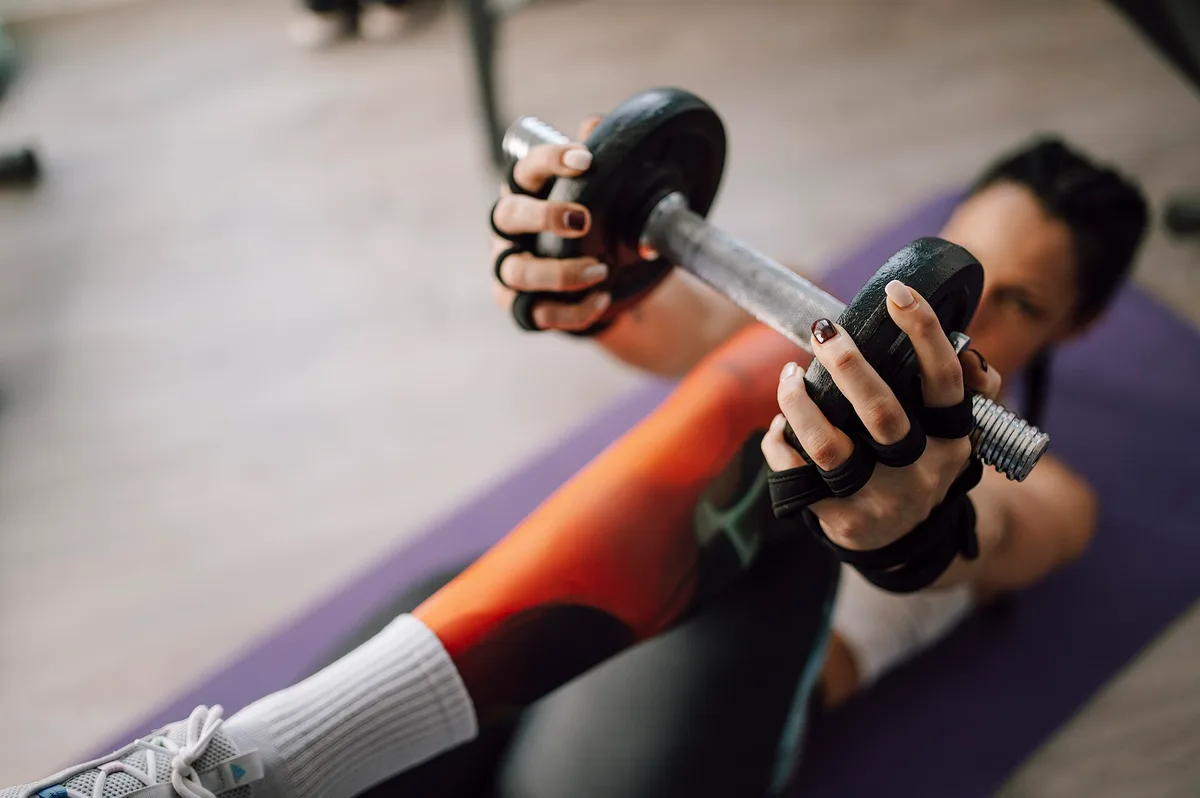
- Learn the floor press first. Lying on the floor with a dumbbell in each hand and pressing upward limits how far the arms can travel, which protects the shoulders while the pattern is new.
- Add a supported press next. Once the floor press feels steady, the same press on a bench allows a longer range of motion.
- Keep the elbows at a comfortable angle. Flaring the elbows straight out to the sides places more stress on the shoulders; tucking them slightly toward the body is the position most coaching guidance describes.
- Stop each set with good form intact. The last repetition should look like the first.
Beginners commonly train the chest alongside other pushing muscles once or twice a week, leaving at least a day between sessions. How much rest muscles need between sessions is its own subject, covered in the recovery timeline explainer. The honest summary of the evidence: muscle recovers over days, not hours, and soreness is an imperfect gauge of readiness. For related coverage, see How Many Rest Days Do Muscles Need? The Recovery Timeline, Explained.
A beginner's session, then, is two or three pressing or flye variations, a few sets of each, and weights light enough that form never breaks down. Progress comes from doing a little more over time — another repetition, then a slightly heavier pair — a principle coaches call progressive overload.
What do intermediate and advanced lifters do differently?
Once the basic press is established, programming gets more deliberate. The levers a lifter can pull are exercise selection, angle, and volume.
Exercise selection. Intermediate lifters usually rotate between a flat press, an incline press, and a flye variation. Changing the bench angle shifts emphasis along the chest, because the pectoral fibers run in more than one direction from the collarbone down to the rib cage. Decline pressing exists as a third angle, though its benefit over the other two is debated in coaching circles and rests more on tradition than on strong comparative trials.
Angle and stability. Advanced variations add instability or a single-arm demand. A one-arm floor press forces the trunk to resist rotation, which brings the core into the movement. A slow-lowering press extends the time the muscle works under load. None of these is necessary for progress; they are tools for lifters who have outgrown the basics.
Volume. Experienced lifters typically spread their chest work across two or more weekly sessions rather than one long one. The logic is fatigue management: many hard sets in a single session degrade the quality of the last ones. Readers who train hard and notice stalled progress, persistent soreness, or disturbed sleep may find the warning signs of overtraining syndrome a useful checklist before adding more volume.
What this means in practice: the advanced difference is not exotic exercises. It is attention to how much work is done, how it is spread across the week, and whether recovery keeps pace.
When should someone see a clinician about chest symptoms?
Muscle soreness after pressing is normal and settles over a day or two. Several signs are different and warrant medical attention rather than another training day, and the general pattern of those signs is consistent across patient-education sources.
- Pressure, squeezing, or pain in the center of the chest during exertion, especially if it spreads to the arm, jaw, neck, or back, warrants urgent medical care.
- Shortness of breath out of proportion to the effort, or breathlessness with chest discomfort, is not a training symptom.
- Sharp pain with a specific movement or a specific position that persists, or pain that follows a strain or a fall, should be assessed before pressing resumes.
- Pain that keeps returning at the same spot over weeks deserves an explanation, not repeated rest.
Chest pain has many possible causes, some of them unrelated to muscle at all. The thorax houses the heart and lungs alongside the chest-wall muscles, and conditions affecting any of these structures can produce similar sensations — a point the anatomy reference above makes plainly when it notes that chest pain is the most common symptom of chest conditions. A person who cannot tell the difference should not try to. The question to bring to a doctor is direct: this pain appears when I press or exert myself — what would need to be ruled out before I resume?
Readers returning to exercise after an illness, an injury, or a long break may also find the evidence on stretching before or after a workout relevant, since warm-up habits are one of the few preparation choices with research behind them.
The takeaways on dumbbell chest training
Dumbbells are a complete tool for chest training at every level. A beginner learns the floor press and a supported press with light weights; an intermediate lifter rotates flat, incline, and flye variations; an experienced lifter manages volume across the week and watches recovery. The equipment itself is the least important part of the plan — consistency, controlled progression, and honest attention to symptoms matter more than any single exercise.
What the evidence supports is modest and clear: pressing movements strengthen the chest and its assisting muscles, and dumbbells allow that work with a free path for the shoulders and independent loading for each arm. What remains uncertain is the finer question of which exact angle, tempo, or set scheme is optimal, where comparative research is thin and coaching tradition fills the gap. Anyone with chest symptoms during exertion should raise them with a clinician before continuing, and anyone starting from scratch can begin light, learn the pattern, and progress only when form holds.