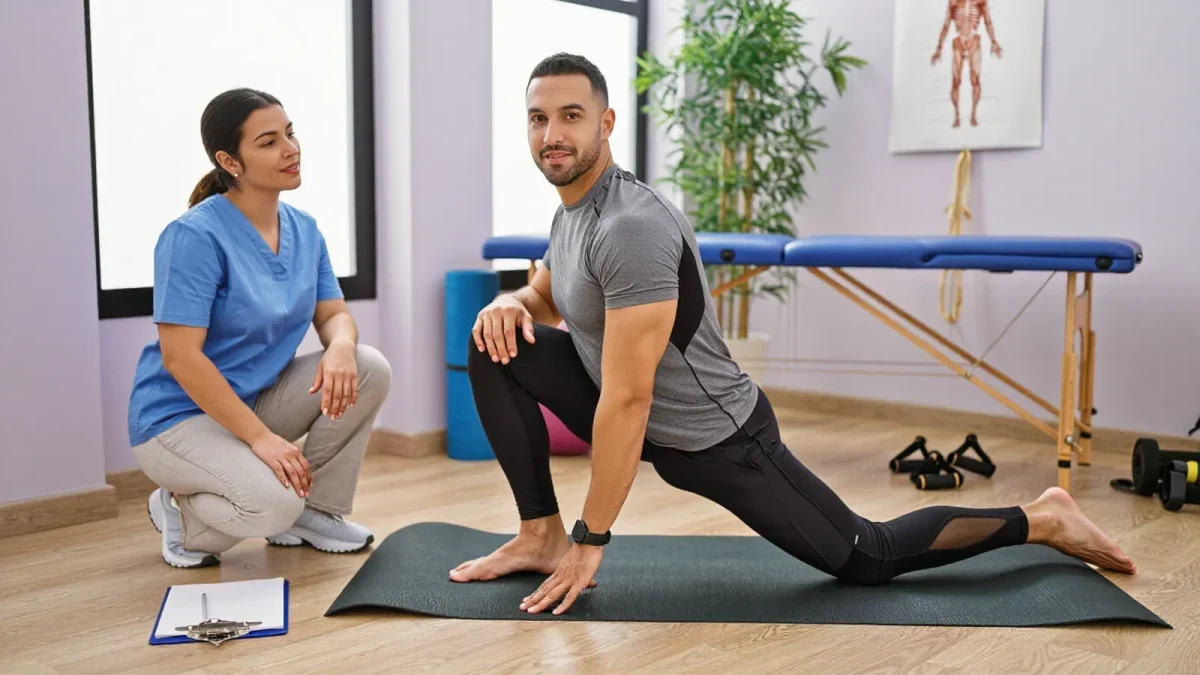

The evidence favors a split decision: dynamic movements before a workout and static stretching afterward, because trials and reviews have found that pre-exercise static stretching neither reduces injury risk meaningfully nor reliably improves performance, while short warm-up movement does both jobs better. The old routine of long toe-touch holds before running has little research support.
What do the two types of stretching actually do?
Static stretching means holding a muscle in a lengthened position for a period, commonly 15 to 60 seconds. Dynamic stretching means moving joints and muscles through their range of motion in a controlled, repeated way — leg swings, walking lunges, arm circles — without holding the end position.
Physiologically, the two do different things. Static holds transiently reduce muscle stiffness and have been associated with acute decreases in force production; a 2013 systematic review in the Scandinavian Journal of Medicine and Science in Sports found that static stretching before exercise reduced maximal strength, explosive power, and explosive performance by small but measurable amounts, with effects shrinking as total stretch time per muscle dropped below 45 seconds. Dynamic movement, by contrast, raises muscle temperature and reheares the movement patterns about to be trained, which is closer to what a warm-up is supposed to accomplish.
Does stretching prevent injury?
This is where the traditional advice survives least well. A large 2014 systematic review and meta-analysis covering 12 randomized and controlled trials with more than 23,000 participants found stretching before exercise produced no statistically meaningful reduction in overall injury risk; the same review found warm-up that raised muscle temperature was associated with fewer injuries. A frequently cited 2017 systematic review on running-specific interventions likewise reported that stretching did not prevent running injuries, while research published in 2020 suggested strength training reduced overuse injuries in athletes by close to half.
Static stretching does appear to increase range of motion, both acutely and over weeks of consistent practice. That flexibility benefit is real; the mistake is assuming it transfers directly into injury prevention during the workout that follows.
So what should happen before a workout?
The research-supported pre-workout sequence is simple:
- Two to five minutes of easy aerobic movement — marching, easy cycling, brisk walking — to raise muscle temperature.
- Dynamic mobility moves matched to the session: leg swings and hip circles before running, shoulder and thoracic rotations before lifting.
- Graduated ramp-up — the first set of the actual exercise performed lighter, before full working effort.
For people who enjoy pre-workout static stretching, short holds of 15 to 30 seconds appear to cause little or no performance loss, so the practice is more a matter of preference than harm. The research caveat is duration: prolonged holds on a muscle about to produce maximal force are the version the evidence advises against.
What about after a workout?
Static stretching fits the post-exercise window better. Muscles are warm, no maximal performance is required immediately afterward, and regular post-workout stretching is one of several supported ways to increase range of motion over time. Evidence on soreness is weaker than commonly assumed: reviews have found stretching before or after exercise produces little to no meaningful reduction in delayed-onset muscle soreness. Soreness reflects, in part, micro-damage from unaccustomed effort, and stretching does not appear to reverse it substantially.
A practical post-workout routine holds each major muscle group worked for 15 to 30 seconds, repeated two to four times, with breathing steady and no bouncing. Research suggests meaningful flexibility changes require weeks of regular practice rather than a single session, so consistency matters more than session length.
When does flexibility work matter most?
Goals decide emphasis. Restriction in specific movements — a squat depth limited by ankles, an overhead position limited by shoulders — can justify targeted mobility work, ideally assessed against the movement itself rather than general benchmarks. Adults with desk-bound routines often prioritize hip flexor and thoracic mobility for comfort rather than performance. Older adults deserve particular mention: age-related reductions in range of motion associate with function in daily tasks, and reviews suggest multi-component programs including stretching and strength work support balance and mobility in older populations.
When to see a doctor
Pain during stretching — as opposed to the pull of a lengthening muscle — is a signal to stop and, if it persists, to have the area assessed by a clinician or physical therapist. Sudden sharp pain, a pop followed by weakness or swelling, or a stretch that provokes numbness or radiating symptoms all warrant medical evaluation rather than continued self-treatment. People recovering from muscle strains or surgery should follow a clinician-directed progression, since stretching too aggressively into healing tissue can delay recovery.